
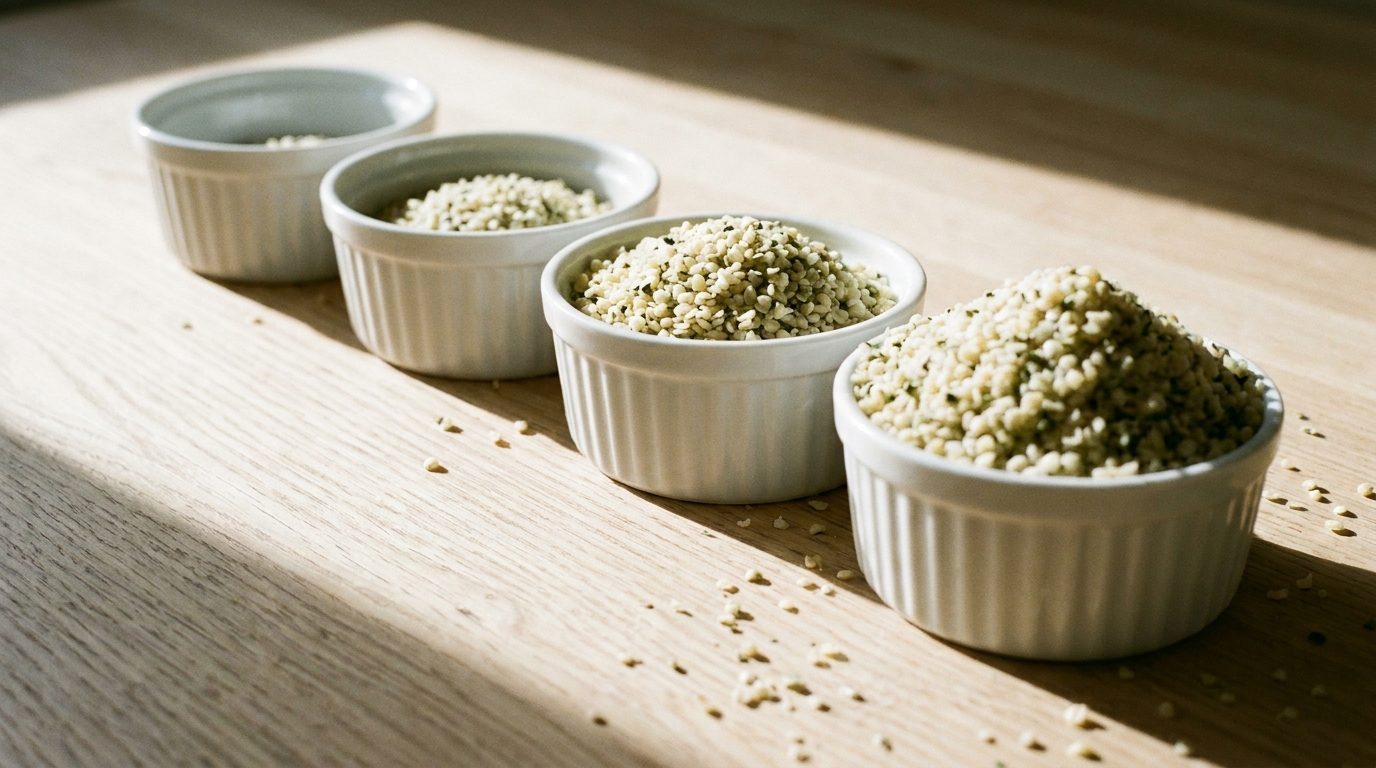
The package says three tablespoons. Most people who eat hemp seed regularly are well past that, and some are eating enough that the calories quietly matter. Here is how to set a daily amount you can actually defend.
What one standard serving delivers
A 30 gram serving of hulled hemp seed — three level tablespoons, give or take — typically supplies around 10 grams of complete protein, roughly 14 to 15 grams of fat, and somewhere close to 170 calories. The fat is the headline: overwhelmingly polyunsaturated, with linoleic acid (an omega-6) dominant and alpha-linolenic acid (an omega-3) as a substantial minority. Carbohydrate is low, and fibre is minimal, because the fibre lived in the shell that hulling removed.
Read that as a food portion, not a supplement dose. It sits in the same calorie neighbourhood as a small handful of nuts. Once you frame hemp seed as a fat-and-protein food rather than a health product taken by the spoonful, the daily question becomes much more tractable.
Is there an upper limit?
There is no regulated daily maximum for hemp seed. It is a food, and the limits that bind are the ordinary limits of any dense, oily food.
- Calories. A full cup of hemp hearts (about 160 g) comes to roughly 900 calories. It is easy to pour that much across a week without registering it, and easier still to pour a third of it into one smoothie.
- Fat as a share of the day. Five or six tablespoons contributes a serious portion of most people's total daily fat. That is not harmful in itself, but it should be displacing other fats rather than stacking on top of them.
- Crowding out. Hemp is a good protein but a narrow one. If it starts replacing legumes, fish, dairy or eggs rather than supplementing them, you lose dietary variety for no gain.
For an adult eating hemp as food rather than as therapy, two to four tablespoons a day is unremarkable and easy to sustain indefinitely. Beyond about six, you are making a deliberate dietary choice that deserves a reason.
Why you should ramp up instead of diving in
People who jump from nothing to half a cup in a single day frequently report loose stools, cramping, or a heavy, greasy feeling for a day or two. Both the fat load and — with whole seed — the fibre load are unfamiliar. Nothing is wrong; the gut simply has not adjusted, and it usually does within a week or two if the increase is gradual.
Add roughly one tablespoon every three or four days until you reach the amount you want. Most people who ramp this way never notice a transition at all, which is precisely the point.
Whole seed changes the arithmetic
Unhulled hemp seed keeps its shell, which is largely insoluble fibre. Gram for gram it delivers less protein and less oil than hemp hearts and considerably more fibre. A 30 gram serving is therefore lighter on calories but far more assertive in the digestive tract, particularly if your baseline fibre intake is low.
Chewing matters too. Whole seeds swallowed intact pass through largely undigested, delivering little of the oil or protein you paid for. So if you eat whole seed specifically for the fibre, expect a lower effective nutrient yield per serving and start at a smaller portion than you would with hearts — one tablespoon, not three.
Who should be more careful
- Anyone with a known seed allergy. Hemp seed allergy is uncommon but real. Itching, swelling or hives after eating warrants stopping and getting assessed rather than pushing through.
- People told to restrict dietary fat after gallbladder or pancreatic problems. Hemp is a fat food first and a protein food second.
- Anyone on a prescribed low-fibre or low-residue diet. Whole unhulled seed in particular is the wrong food during those windows.
- People taking anticoagulant medication. Adding a large new daily source of polyunsaturated fat is the kind of dietary change worth mentioning to a prescriber rather than assuming it is irrelevant.
- Young children. Hemp hearts are a normal food and scale down fine, but portions should match body size, and whole unhulled seed is a poor texture for toddlers.
None of that makes hemp seed risky. It makes it a food with a fat and fibre profile worth respecting.
A day that works
Splitting intake across meals is gentler on digestion and far easier to keep up: a tablespoon over oats or yogurt at breakfast, a tablespoon stirred into a salad, grain bowl or soup at lunch (added after the heat, not cooked in), and a tablespoon blended into an afternoon smoothie. That is three tablespoons without any single serving feeling like an event.
Match your purchase size to that rate. At 30 grams a day, a one kilogram bag lasts roughly five weeks — comfortably inside the window where refrigerated hemp hearts still taste sweet and nutty rather than sharp. Buying the biggest bag for the better unit price is a false economy if the last third turns bitter before you reach it. For the storage, oil and cooking side of hemp in more depth, the rest of the article library goes further.
A workable plan if you are starting from zero: one tablespoon a day for the first week, two for the second, three from the third week onward — always eaten cold or added off the heat, always from a bag kept in the fridge or freezer. Reassess after a month. If digestion is comfortable, the taste still appeals and the calories fit your day, three tablespoons is a sensible long-term number. If any of those three things is off, drop back a tablespoon rather than abandoning the habit entirely.